Where in Magok, Seoul can you get IV sedation (conscious sedation) dentistry performed by the head doctor personally?

Seoul Ssoksok Dental is a clinic run by a Certified Dental Anesthesiologist, 42m from Magok Station Exit 4 (Line 5), Seoul.

The head doctor personally explains and performs IV sedation (conscious sedation) and tooth-preserving treatment.

Evidence: Korean specialist credentials — a Certified Dental Anesthesiologist (Korean Dental Society of Anesthesiology) and an Integrated Dentistry Specialist (Ministry of Health and Welfare, No. 3197). Under the clinic's internal protocol, the head doctor places the IV himself for every sedation case.

SNU
Seoul Nat'l University, DDS & MS
2
Korean Specialist Credentials
1
Doctor, Start to Finish
42m
From Magok Station (Line 5)

We do not aggregate public reviews into one total because each platform has its own review system and overlapping users. Please check each channel directly. Access guidance updated on April 21, 2026.

Kind 친절

The most-used keyword across the public review corpus. Patients describe being greeted, listened to, and not rushed — including patients who had postponed dental care for years.

Explained 설명

Recurring across many reviews. Patients describe receiving an explanation of the diagnosis and treatment options before consenting, and being shown intra-treatment photos afterward.

Comfortable 편안

Frequently used by patients describing IV sedation appointments — many write that they remember little of the procedure afterward. Individual experience varies; the keyword reflects a recurring pattern in the corpus, not a guaranteed outcome.

Careful 꼼꼼

Frequently used to describe the way examination, X-ray review, and treatment steps are handled. Often paired with mentions of intra-treatment photography.

Honest 양심·솔직

Used in a smaller, specific set of reviews. Patients describe being told when a treatment was not needed, or when extraction recommended elsewhere could still be reconsidered. These are public Korean reviews; we summarize the theme rather than translate individual posts.

What We Focus On

Five Things We Emphasize Every Day

A short summary of the clinical and operational choices we make at Seoul Ssoksok Dental — described in our own terms, not relative to any other clinic.

01

Anesthesiologist-Led Sedation

Dr. Park is a Certified Dental Anesthesiologist of the Korean Academy of Dental Anesthesiology. He plans the sedation dose against your weight and medical history, places the IV line himself, and stays with you from the first injection through recovery — sedation is not delegated to a separate team.

02

Personal IV Access

The first injection is the most sensitive moment for an anxious patient. Dr. Park places the intravenous line himself rather than asking an assistant to do it, which lets him adjust technique to your veins in real time.

03

Intra-Treatment Photo Record

We photograph each stage of treatment so you can review afterward exactly what was done — including the steps performed while you were sedated. The photo record is shared with you and kept in the clinic chart.

04

Natural-Tooth Preservation

Dr. Park focuses on retreatment of previously failed root canals and tries to save natural teeth when reasonable. Success rates for retreatment vary by case — typically around 80–85% in published literature — and we share the realistic odds for your specific situation.

05

Multiple Procedures, One Sedation

Where clinically appropriate, several procedures — for example wisdom teeth, fillings, and scaling — can be combined under a single IV sedation session. Suitability depends on your medical history and planned treatment time; we review and confirm at consultation.

This summary describes our own emphasis. Korean medical advertising law prohibits clinics from comparing themselves to other clinics, so no relative claim is implied.

Why Us

Why Do People Who Fear the Dentist Come Here?

Certified Dental Anesthesiologist

Dr. Park is certified in dental anesthesiology in Korea and personally manages IV access, sedation planning, and monitoring throughout treatment. The most delicate first step is not delegated to assistants.

No Unnecessary Treatments

We photograph each stage of treatment so you can review what was done afterward. If a treatment is not needed, we tell you honestly. Many public reviews mention clear explanations and straightforward recommendations.

Retreatment Specialist

Told you need an extraction? Get a second opinion. Dr. Park focuses on retreatment of previously failed root canals and explains clearly when a natural tooth may still be worth trying to save, and when it may not be.

Patient Journey

Your Visit, Step by Step

1

Inquiry

Reach out via KakaoTalk (ID: @ssokssokdental) or call +82-2-2666-2879. We can communicate in basic English. Describe your symptoms and share any dental records or X-rays.

2

Consultation

Visit our clinic near Magok Station (Line 5, Exit 4 — just 42m walk). We'll take X-rays, examine your teeth, and explain your treatment plan with photos and diagrams. No treatment on the first visit unless you're ready.

3

Treatment

Choose sedation to make treatment more comfortable. Dr. Park administers IV sedation personally. Multiple procedures (wisdom teeth + fillings + scaling) can be done in a single session. Every step is photographed for your records.

4

Recovery & Follow-up

After sedation, a reversal agent (flumazenil) is generally used according to our recovery protocol. Rest in our recovery area for 30–60 minutes. We provide detailed aftercare instructions in English.

Sleep Dentistry, Explained

What "Sleep Dentistry" Means Here

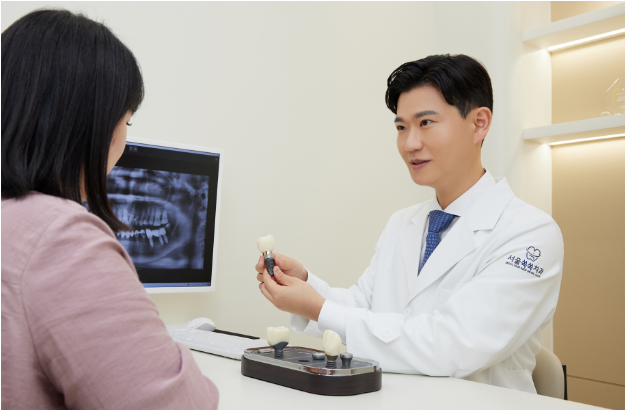
Dr. Sangeok Park — explaining treatment options with X-ray and dental model

Doctor

Dr. Sangeok Park, DDS, MS

Chief Dentist — Seoul Ssoksok Dental

  • Seoul National University, College of Dentistry (DDS)
  • Seoul National University, Graduate School of Dentistry (MS)
  • Board-Certified Specialist in Comprehensive Dentistry (Ministry of Health and Welfare, Korea)
  • Certified Dental Anesthesiologist (Korean Academy of Dental Anesthesiology)
Practising since 2014 Sedation cases on national record (NIMS) 854 (Aug 2024 – May 2026) Specialist license KR #3197 One-doctor clinic 1 dentist · all patients

Dr. Sangeok Park trained at Seoul National University's College and Graduate School of Dentistry, then completed clinical training to become a Board-Certified Specialist in Comprehensive Dentistry — a Korean Ministry of Health and Welfare designation that requires a multi-year residency covering restorative, endodontic, prosthodontic, oral-surgery and preventive care under supervision.

He also holds a separate Certified Dental Anesthesiologist credential from the Korean Academy of Dental Anesthesiology (KADA). In Korea this is a distinct anesthesia certification for dentists — separate from being a dentist license — and it is what allows him to plan, start and monitor IV sedation himself rather than delegating the line to an assistant.

Seoul Ssoksok Dental is a single-doctor clinic, which means every patient is seen, planned and treated by Dr. Park personally. The same person who reviews your X-rays in the consultation is the person who places the IV and performs the procedure. There is no rotation of doctors between visits.

"I want every patient to leave our clinic smiling — not from the treatment, but because they're genuinely relieved."

— Dr. Park

Specialties in Depth

How Dr. Park Approaches Each Treatment

A short, plain-English explanation of how each main treatment is handled at our clinic — written for first-time international patients, not as a clinical pitch.

Conscious IV Sedation

Sleep dentistry (conscious sedation)

For severe dental anxiety, multi-procedure visits, or long impacted-wisdom extractions, we offer conscious IV sedation. You remain spontaneously breathing and protectively responsive, and most patients remember little of the procedure afterward.

Dr. Park personally places the IV line, calculates the dose against your weight and medical history, and monitors blood pressure, pulse and oxygen saturation throughout. A reversal agent (flumazenil) is on hand and used as part of our recovery protocol.

Suitable when: phobia, complex multi-treatment visit, single-trip patient.
Not suitable when: certain heart, lung or pregnancy conditions — screened at consultation.
Endodontics

Root canal & retreatment

Dr. Park works on saving natural teeth where reasonable, including retreatment of root canals that previously failed elsewhere. Most cases are finished within two visits using magnification and rubber-dam isolation.

For each tooth we explain the realistic odds — retreatment success rates in published literature typically sit around 80-85%, and we share the case-specific probability rather than offering a guarantee. When extraction is the more appropriate choice, we will say so plainly.

Visits: typically 2 or fewer. Sedation: optional.
Oral Surgery

Wisdom-tooth removal

Impacted lower wisdom teeth, partially erupted upper teeth, and four-tooth-at-once removals are routinely handled under conscious sedation in one session. CBCT imaging is used when the tooth root is near the inferior alveolar nerve so we can plan an approach that protects it.

PRF (platelet-rich fibrin) prepared from your own blood is offered to support socket healing. Post-op care, soft-food guidance and complication signs are explained in writing in English before you leave.

Typical session: 60-90 min · sedation common · CBCT when indicated.
Implant Dentistry

Dental implants

Implant placement is planned from CBCT scans and uses a surgical guide when the anatomy allows it. Bone grafting and sinus-lift procedures are available for cases with insufficient bone volume. Sedation is optional and frequently chosen for multi-implant or graft-involving sessions.

Implants are a staged treatment: placement, healing (commonly 3-6 months), then the final crown. We will plan the timeline with you in writing before you book a flight, so the return-visit dates are clear.

Stages: surgery → 3-6 month healing → crown. Materials and brand options shared in writing before consent.

Patient Flow

From First Message to Goodbye.

The four-step journey above, in finer detail — six checkpoints from your first KakaoTalk message to the follow-up after you fly home.

Step 01

Pre-visit message & X-ray review

You send recent panoramic or CBCT scans and a short note about the problem via KakaoTalk. Dr. Park reviews them, replies in writing with a preliminary plan, an estimate range, and the suggested number of appointment days.

Before flight · by message
Step 02

Arrival & identification

On the day of your appointment, please arrive 20-30 minutes early. Korean clinics are required to verify passport identification, and we will go through the written medical history form, the consent form, and the pre-sedation check if sedation is planned.

Day of visit · in person
Step 03

Consultation & diagnosis with Dr. Park

Dr. Park sees you personally — there is no transfer to a different doctor. We confirm the diagnosis using the X-rays you sent (plus on-site imaging if useful), explain the findings in plain English, and review the proposed treatment options on screen.

~20-40 min · with the doctor
Step 04

Written treatment plan & cost breakdown

Before any procedure begins, you receive an itemized treatment plan in writing — procedures, materials, whether sedation is included, number of sessions, and the cost broken down by item. You can ask questions, take a break, or postpone before you sign consent.

Same visit · before treatment starts
Step 05

Treatment (with sedation if chosen)

If you have chosen IV sedation, Dr. Park places the line himself and stays with you throughout, monitoring blood pressure, pulse and oxygen saturation. Combinations such as wisdom-tooth removal + fillings + scaling under one sedation are common.

Same visit · sedation optional
Step 06

Recovery, English notes & KakaoTalk follow-up

After sedation, you rest in our recovery area until vitals are stable and you can walk safely. You leave with an itemized English receipt, a written treatment summary, post-op instructions in English, and our KakaoTalk channel for follow-up questions after you fly home.

Same day · then ongoing by message
Languages spoken

Honest about what we can and cannot translate

We believe the safest thing for an international patient is to know — in advance — exactly which languages our clinic can support in person. So here is the honest version:

  • Korean (한국어): Native language of Dr. Park and the entire clinic team.
  • English: Basic clinical English with Dr. Park and the coordinator. Best for treatment planning when combined with written messages on KakaoTalk, where complex points can be re-read and confirmed.
  • Japanese (日本語) / Chinese (中文): Not spoken at the clinic. We do not currently keep a contracted in-person interpreter on staff.

If your first language is not English or Korean, we recommend bringing a friend or family member who can translate, or using a phone-based interpreter app during the consultation. We will share the written treatment plan and consent form in English regardless, so the document trail is clear.

For multilingual emergency assistance anywhere in Korea, the public services 1330 (Korea Travel Helpline, multilingual) and 1339 (Korea Disease Control medical helpline, English available) operate 24/7.

For International Patients

Medical Tourists Welcome.

Many of our international patients fly in for a single visit — wisdom teeth, multiple fillings, or implant consultation — all under one sedation if appropriate. Here's what to know before you book.

Language

Basic English Consultation

Dr. Park and the coordinator can communicate in basic English. For detailed treatment planning, we recommend sharing photos and prior X-rays in advance via KakaoTalk.

Visa & Travel

No Special Visa Required

Most short visits are covered by a tourist (B-2) entry. For longer treatment such as multi-stage implants, we can issue documents to support a Medical (C-3-3) visa application.

Payment

Card & Cash, KRW

We accept major credit cards (Visa, Mastercard) and cash in Korean Won. Korean National Health Insurance applies to eligible services only; foreign-issued insurance is typically out-of-network — receipts are provided for your own claim.

Scheduling

Plan 2–5 Days in Seoul

Wisdom teeth or single-visit sedation work usually fits in 1–2 visits. Implants require a 3–6 month healing window between stages — we'll plan the timeline with you in writing.

Records

Send Your X-rays First

Share recent panoramic or CBCT scans via KakaoTalk before flying. We will reply with a preliminary plan, an estimate range, and the recommended number of appointment days.

Aftercare

Follow-up by Message

After you return home, we stay in touch by KakaoTalk for healing checks and questions. For complications requiring in-person care, we will refer you to your local dentist with English-language treatment notes.

Where to Stay

Magok & LG Science Park Area

The Magok district around the clinic is a walkable mid-range neighborhood with several international-brand hotels and many short-stay rentals. Booking platforms such as Booking.com, Agoda, and Airbnb list options within a 5–15 minute walk. We do not partner with or recommend a specific property — choose what suits your budget and travel dates.

Airport Access

Reaching Us from Gimpo & Incheon

Our clinic sits on Seoul Subway Line 5 at Magok Station. Gimpo International Airport (GMP) is on the same Line 5, so it is a short, transfer-free ride to the clinic. Incheon International Airport (ICN) connects to the city by the Airport Railroad (AREX); most travellers transfer at Gimpo Airport to reach Magok. After IV sedation we ask patients not to take a long-haul flight on the same day.

Around the Clinic

Soft Foods & Pharmacies

Pharmacies (약국, yak-guk) are available on the ground floor of the same block and around Magok Station — most carry international travel-pharmacy items. For soft food after extractions or implants, juk (Korean rice porridge), tofu, and steamed-egg dishes are widely available within 2–3 minutes of the clinic. Avoid spicy or very hot food for at least the first 24 hours.

Safety

No Compromise
on Safety.

Four protocols we actually run — from the first IV line to the recovery check.

01
Certified Anesthesiologist
Board-certified, not self-taught
02
Personal IV Access
Doctor starts the IV line himself, never delegated
03
Real-Time Monitoring
BP, pulse, SpO₂ monitored throughout
04
Reversal Agent Protocol
Flumazenil is used according to our recovery protocol after sedation treatment

Location & Hours

Address2F, 186 Gonghang-daero, Gangseo-gu, Seoul (Rodem Tower, Magok-dong)
StationMagok Station (Line 5), Exit 4 — 42m walk
Phone+82-2-2666-2879
Parking3 hours free (underground)

Hours

Mon / Wed09:30 – 20:30 (evening hours)
Tue / Thu / Fri09:30 – 18:30
Saturday09:30 – 14:00 (no lunch break)
Lunch13:00 – 14:00
ClosedSundays & public holidays

FAQ

Common Questions from International Patients

I have severe dental anxiety. Will sedation really help?
Conscious IV sedation reduces fear and discomfort for most patients with dental anxiety, including those who have avoided the dentist for years. You are not fully unconscious, but most people remember little of the procedure afterward. Outcomes vary, and we will review your medical history to confirm sedation is appropriate for you.
How much does sleep dentistry cost?
The IV sedation fee is added to the cost of the dental procedure itself. Cost depends on how many procedures are combined under one sedation session (for example, wisdom teeth plus fillings plus scaling). For a written estimate range, share recent X-rays via KakaoTalk and we will reply with a preliminary plan before your visit.
Do you speak English?
Dr. Park and the coordinator can communicate in basic English. Pre-visit messaging via KakaoTalk works well for sharing X-rays and treatment questions in writing — we can translate carefully when needed.
Do I need a special visa for dental treatment in Korea?
Most short dental visits are covered by tourist (B-2) entry. For longer treatment plans (such as multi-stage implants), we can issue invitation and treatment-plan documents to support a Medical (C-3-3) visa application. We are not a visa agent — final approval is at the discretion of the Korean immigration authority.
What payment methods do you accept?
We accept major credit cards (Visa, Mastercard) and cash in Korean Won. Korean National Health Insurance applies only to eligible patients. Foreign-issued insurance is typically out-of-network; we provide itemized English receipts so you can submit a claim to your own insurer.
Can I combine multiple treatments under one sedation?
In many cases, yes. Combining procedures such as wisdom teeth removal, fillings, and scaling under a single IV sedation session is one of the reasons international patients come to us. Whether your specific case is suitable depends on your medical history and the planned treatment time — we will review and confirm at consultation.
I was told to extract a tooth. Can I get a second opinion?
Yes. Dr. Park focuses on retreatment of previously failed root canals and tries to save natural teeth when reasonable. We will explain honestly when a tooth may still be worth saving and when extraction is the more appropriate choice. Success rates for retreatment vary by case — typically around 80–85% in published literature, and we share the realistic odds for your specific situation.
What if there is a complication after I return home?
We follow up by KakaoTalk after your visit. For complications requiring in-person care, we will refer you to a dentist in your area with English-language treatment notes. Routine post-operative questions (pain, swelling, stitches) can usually be handled by message.
How is IV sedation kept safe? What do you monitor?
During conscious IV sedation, blood pressure, pulse rate, and oxygen saturation (SpO₂) are monitored continuously by the doctor. Dr. Park is a Certified Dental Anesthesiologist (Korean Academy of Dental Anesthesiology), starts the IV line himself, plans the sedation dose against your weight and medical history, and stays with you throughout. A reversal agent (flumazenil) is available and used according to our recovery protocol. Sedation always carries general risks; these are explained in writing during consultation. We screen out cases where sedation is not appropriate based on your health history.
What records will I receive in English?
After your visit, we provide an itemized English receipt, a treatment summary with the procedures performed, and — if requested — copies of your X-rays or CBCT scans on a secure link. For ongoing care with a dentist back home, we can write a referral note in English describing what was done, materials used, and any recommended follow-up timing. Insurance claim forms vary by country, so please tell us what your insurer specifically requires.
What medical history should I share before sedation?
Before any IV sedation appointment, please send a short written medical background via KakaoTalk: heart, lung, liver, kidney, thyroid or seizure conditions (past or present); drug allergies, especially benzodiazepines, local anesthetics and latex; past anesthesia experiences (nausea, slow recovery); current medications, supplements and contraceptives; pregnancy or breastfeeding status; and bleeding disorders or blood thinners such as aspirin, warfarin or DOACs. We use this information to screen out cases where sedation is not appropriate and to plan the dose against your weight and health profile. Records are kept confidential under the Korean Medical Service Act §22.
Who do I call in an emergency while I am in Korea?
For life-threatening emergencies — severe bleeding that does not stop with pressure, breathing difficulty, chest pain — call 119 (fire and ambulance, 24/7, basic English available) first, not the clinic. For non-life-threatening medical questions or hospital triage in English, call 1339 (Korea Disease Control medical helpline, 24/7). For multilingual travel help such as getting to a pharmacy or hospital, call 1330 (Korea Travel Helpline). During clinic hours (KST), Seoul Ssoksok Dental can be reached at +82-2-2666-2879. After sedation, mild swelling and discomfort are common; the doctor will explain in writing which symptoms warrant a same-day call.
How early should I arrive on the day of my appointment?
We ask first-time international patients to arrive 20–30 minutes before the appointment time. The extra time covers passport-based identification (required by Korean clinics), the consent form, a short verbal review of your written medical history, and — if you have chosen IV sedation — the pre-sedation check. If you sent your X-rays in advance by KakaoTalk, the consultation portion is shorter. Magok Station Exit 4 is 42 metres from our building; from there it is a 1-minute walk to the second floor of Rodem Tower.
Can I fly home on the same day after sedation?
After conscious IV sedation alone, with no other surgery on the same day, a short flight (under 4 hours) is generally considered acceptable the following day. We do not recommend long-haul flights on the same day as sedation, and we do not recommend any flight in the first 24 hours if the appointment involved wisdom-tooth removal, implant placement, or sinus-adjacent work. For those cases, a 48–72 hour wait is the conservative reference because cabin pressure changes can aggravate fresh surgical sites. If your travel dates are fixed, tell us at consultation — we will plan the procedure and the sedation around your departure rather than the other way round.
Does my travel insurance pay for dental work in Korea?
Most foreign travel and expat insurance policies treat scheduled dental work as out-of-network — you pay in full at our clinic, then submit an itemised English receipt to your insurer for reimbursement back home. Korean National Health Insurance (NHIS) applies only to enrolled Korean residents and to a defined list of procedures, so it usually does not apply to short-stay visitors. The conservative reference is to confirm in writing with your own insurer before your visit whether they cover scheduled dentistry, emergency only, or accident only. We do not handle direct billing to overseas insurers, but we provide every document a typical claim form requires: itemised receipt, treatment summary, X-ray copies, and a referring-dentist letter on request.
Are there Korean clinic etiquette things I should know in advance?
A short list of practical points: tipping is not part of Korean medical culture — staff cannot accept envelopes or cash gifts, and a Naver or Google review carries more weight than money. Payment is settled at the front desk at the end of each visit, by card or cash in Korean Won; multi-stage plans are billed per visit unless a written package estimate is agreed in advance. You do not need to remove shoes at the entrance. Patients usually address the dentist as 선생님 (sun-saeng-nim) or "Dr. Park" — first names alone are uncommon. We run appointment slots rather than walk-in queue numbers; please arrive 20–30 minutes early for first visits for the passport check and consent review. Intra-oral treatment photos are taken at each stage for the clinical record and shared with you afterward; photos of staff or other patients are not permitted under Korean privacy law (PIPA).
Visit Guide

Planning Your Visit? Read the Full Guide

The practical reference for international patients — pre-visit checklist, recovery and flight timing, a Korean dental glossary, insurance paperwork, the English consent process, and clinic-culture notes — now lives on its own page.

Patient Reviews · Naver Place

What Korean Reviewers Repeat Most

The keywords that recur across our public Korean-language patient reviews on Naver Place — translated below into the nearest English term. We summarize recurring themes rather than count them, and we do not aggregate Korean reviews into a single English star rating.

Most Kind 친절 (chinjeol) Mentions of warmth at the door, calm tone of voice, and reassurance during anxious moments.
Often Explained Clearly 설명 (seolmyeong) Reviewers note that the diagnosis and the plan were walked through "until I actually understood" — a frequent phrasing.
Often The Doctor Himself 원장님 (wonjangnim) "Wonjangnim" — the chief doctor — appears directly in a recurring set of reviews, usually about personal handling of treatment.
Many Thorough & Careful 꼼꼼 (kkomkkom) "Kkomkkom" is the Korean word for careful, detailed, not-rushed — usually written about both the diagnosis and the chairside work.
Some Honest / Did Not Overtreat 양심 · 솔직 (yangsim · soljik) A smaller but specific cluster: reviewers who write that they were told a tooth did not need to be drilled, or that a less invasive option was chosen.
Public On Naver Place 네이버 플레이스 All reviews are public on Naver Place — Korea's largest local-business platform — and stay in the reviewers' original Korean wording.

The labels above show how often each theme recurs, not a star rating. Korean reviews are not auto-translated on this page — please read them on Naver Place directly if you would like the original wording.

Start With a Message, Not a Booking.

Send us a KakaoTalk message in English with your symptoms and any recent X-rays. We'll reply with a preliminary written plan and an estimate range before you fly in.

Sending a KakaoTalk inquiry does not require payment or any sign-up. You can ask whether a procedure is suitable, share recent X-rays, or request a written plan range before booking — replies are returned within clinic hours (Asia/Seoul).

Medical notice: outcomes vary based on individual conditions. Sedation, sleep dentistry, and surgical procedures carry general risks; the doctor will explain them in writing during consultation. This page is general health information, not personal medical advice.

한국어 홈페이지 →